
Aircraft Polishing vs Wax vs Ceramic Coating: Which One Actually Protects Your Paint?

Updated: 4 days ago

The Truth Most Aircraft Owners Don’t Hear
When someone says they’re going to “polish your aircraft,” what they’re really saying is:
They’re going to remove a layer of your paint or clear coat. That’s not marketing spin, that’s physics.

Polishing is an abrasive process designed to remove oxidation, scratches, and imperfections by leveling the surface. Done correctly, it restores appearance. Done repeatedly or incorrectly, it shortens the life of your paint system.
At JetGlow, we approach this differently. We treat aircraft condition as maintenance, not cosmetic correction. Let’s break down the three common approaches and what they actually mean for your aircraft.
1. “Just Polishing” an Aircraft
This is the most misunderstood and most abused service in aviation detailing.
What It Is:
Machine polishing using compounds
Removes oxidation, staining, scratches
Leaves a clean, glossy surface
What It Does to Your Aircraft:
Removes measurable paint or clear coat thickness
Temporarily improves appearance
Leaves the surface unprotected
The Problem:
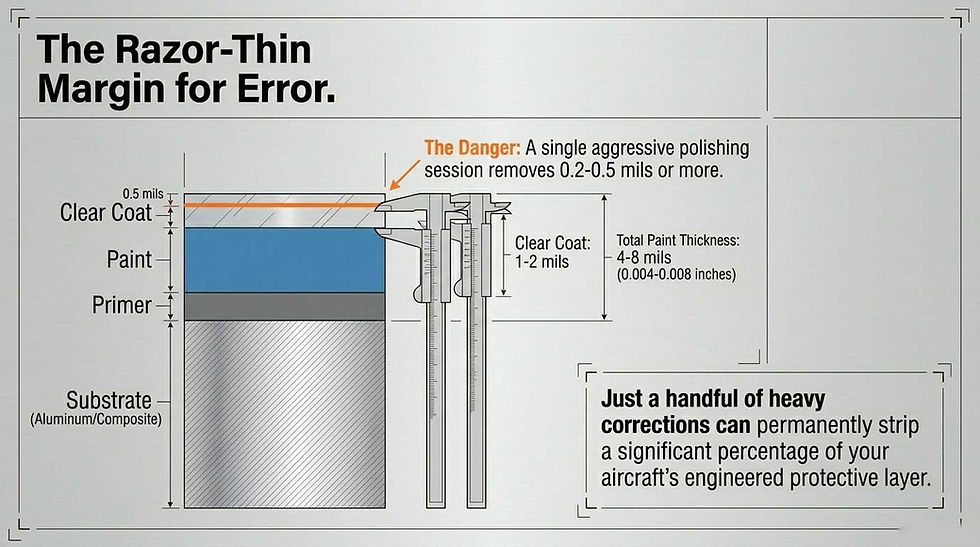
Every time you polish, you’re thinning the protective layer of your aircraft. Aircraft paint systems are not infinitely thick:
Typical total paint thickness: 4–8 mils (0.004–0.008 inches)
Clear coat (if present): often 1–2 mils
Aggressive polishing session: can remove 0.2–0.5 mils or more
That means just a handful of heavy corrections can remove a significant percentage of your protective layer.
Bottom Line:
Polishing alone is a reset tool, not a maintenance strategy.
2. Polishing + Waxing an Aircraft
This is the “traditional” detailing model most operators are familiar with.
What It Is:
Polish to correct the surface
Apply wax for protection
What Wax Actually Does:
Adds a temporary protective layer
Enhances gloss and hydrophobic properties
Protects against UV and contaminants for a short time
The Reality:
Wax protection:
Typically lasts 4–12 weeks
Breaks down quickly under:
UV exposure
Heat cycles
Hydraulic fluid, oil, and exhaust contamination
The Problem:
To maintain appearance, aircraft often get:
Re-polished
Re-waxed
Re-polished again
This creates a cycle of repeated material removal.

Bottom Line:
Better than polishing alone, but still a reactive cycle that slowly degrades your paint.
3. Polishing + Ceramic Coating (The Modern Approach)
This is where professional aircraft condition maintenance is heading.
What It Is:
Perform a controlled, minimal polishing correction
Apply a ceramic coating that bonds to the surface
What Ceramic Coatings Do:
Create a semi-permanent protective layer
Increase chemical resistance (fuel, oil, exhaust)
Provide strong UV protection
Reduce contamination bonding
Maintain gloss significantly longer
The Advantage:
Less frequent polishing required
Paint system is preserved
Cleaning becomes easier and safer
Real Impact for Operators:
Reduced long-term paint degradation
Lower lifecycle maintenance cost
Improved appearance consistency
Better resale and asset value

Bottom Line:
This is a proactive protection strategy, not a cosmetic fix.
Why Polishing Is Actually “Bad” for Your Aircraft (When Misused)
Let’s be clear, polishing itself isn’t the enemy. Uncontrolled, repeated polishing is.
Here’s Why:
1. You Are Removing Protective Material
Paint and clear coat exist to:
Protect aluminum and composite structures
Resist corrosion
Shield against UV degradation
Every polishing step reduces that protection.
2. Aircraft Paint Is Thin Compared to Automotive Paint
Aircraft coatings are engineered for:
Weight efficiency
Flexibility
Environmental durability
Not repeated heavy correction.
Once you remove too much:
You cannot “add it back” without repainting
3. Over-Polishing Leads to:
Premature paint failure
Fading and chalking
Increased oxidation rates
Higher long-term cost (repaints are not cheap)

The JetGlow Philosophy: Condition as Maintenance
At JetGlow, we don’t sell polishing as a routine service.
We use it as a controlled reset, then shift to preservation.
Our Approach:
Correct only what’s necessary
Measure and document condition
Protect (Ceramic or Approved Systems)
Lock in the corrected surface
Maintain (JetGlow ORBIT Program)
Regular washes and condition tracking
Prevent degradation before it starts
Avoid repeated polishing cycles
The Real Question You Should Be Asking
Not:
“How shiny can you make my aircraft?”
But:
“How long can you preserve my paint without removing it?”
That’s where the value is.

Final Thoughts
Polishing has its place, but it should be used carefully and strategically.
Polishing alone = short-term gain, long-term loss
Polish + wax = temporary improvement, ongoing cycle
Polish + ceramic + maintenance = long-term protection and asset preservation
If you treat your aircraft like a car, you’ll eventually pay for it like an aircraft.
Ready to Protect Your Aircraft the Right Way?
JetGlow is based at Wittman Regional Airport (KOSH) in Oshkosh, Wisconsin, providing professional aircraft condition maintenance for owners, operators, and flight departments.
Every flight deserves a JetGlow! Click the link below or call us for a free consultation 920-203-2888


Comments